Showing posts with label monument. Show all posts

February 12, 2012

Garuda

Ancient Carving of Hindu mythical character Garuda. Garuda appears both in Hindu and Buddhist mythology. Garuda has wings of an Eagle (Brahminy Kite in Indian version) and body of a man, he is also a carrier of god Vishnu.
Photo Location: Krishna temple courtyard, Hampi.

February 1, 2012

Band Tower, Hampi

Band Tower is on of the tall structures found within a large compound of Danaik's Enclusure in Hampi.  This structure dates back to 13th century and this is the only structure in Danaik's Enclusure which is still in good shape.  Its a two-storied hexagonal building with narrow stairways leading to the top. There is no clear information as to why this is called Band Tower, one of the localite told me that if we clap standing in the center of the ground floor of this building, sound is amplified and sounds like its from a band {it sure does because I tried it :)} but looks like this structure was a watch tower more than a band tower.

Another prominent structure in this enclosure is the Mosque (stone structure seen next to the band tower in the picture).  It is said that this Mosque was originally a temple, later converted to a mosque when muslims invaded Vijayanagara Empire.

(Converted the image to B&W and added texture just to get a feel of the bygone era.)
Band Tower of Hampi

September 12, 2011

Caption This


Creative Exchange / Our World / Sweet Shot / Fabulous Friday
Wordless @ Project Alicia, Angry Julie, Betterinbulk, Supermom, liveandloveoutloud, 5minutesformom, bywordofmouth, andthen-shesnapped,
------------------------------ x ---------------------------- x ------------------------------

Previous Caption This post:
Many of you asked if this place was flooded and why is the boat so low, No this place was not flooded, this man accompanied by his kid was transporting bricks to a nearby construction site. Boat was low probably because of the weight of the bricks.  This photo was shot in Alleppy, waterway is the main means of transport here. Alleppy is called as "Venice of India."

View More photos from this place here.


Here are some of your Captions/Comments:
Heart to heart. Man to man – lisa
Son, you are not baling fast enough..! – Jackie
Dad, next time can we get a boat thats a bit shorter, but not as close to the water please? - Stewart M
Ummm... Dad, are we sinking? – Vicki / Dad, are we sinking? - Kim, USA
Don't rock the boat, don't rock the boat baby – Mallory
Powered by one and a half men – 2sweetnsaxy
Dad, can't we stop and ask directions now? – Stacia
Is it just me, or is the water level getting higher? - Red Nomad OZ
Dad! My science teacher taught me that if you put too much weight on one end of a scale, it tips! Does that apply to boats? - Gemma Wiseman
All are needed by each one. Nothing is fair or good alone - hip-chick

June 13, 2011

Stone Chariot, Hampi

Stone Chariot, an iconic structure of Vijayanagara Empire is located in Vijaya Vittala Temple complex at Hampi, it dates back to 15th century. This in fact is a shrine built in the form of a temple chariot. Temple chariots are often mobile reproductions of a temple the stone chariot here is in turn a static version of the mobile temple chariot. An image of Garuda (The Eagle, vehicle of lord Vishnu according to Hindu mythology) was originally enshrined within its sanctum.

Even though it appears as a monolithic structure, in reality its built with many giant granite blocks. The joints are hidden in the carvings and other decorative features that adorn the chariot. The chariot is built on a rectangular platform and mythical battle scenes are carved all around this platform.  Chariots stone wheels mimics the real life wheels with shaft and breaks and are capable of revolving, this represents the creativity of the 15th century artists of Vijayanagara Empire.
In front of the chariot two elephants are positioned as if they are pulling the chariot. It is said that these elephants where brought from elsewhere and positioned here at a later stage. Originally two horses were carved in that position. The tail and the rear legs of the horses can be still seen just behind these elephant sculptures. A small stone ladder which once gave access to the inner sanctum can be still seen between two elephant structures.

April 18, 2011

Nandi

Nandi (Bull) - In Hindu Mythologyis Nandi is Lord Shiva's primary vehicle and is the principal follower of Shiva and also gate keeper of shiva and parvathi. Temples dedicated to shiva and parvathi will have stone images of seated Nandi facing the main shrine.

This giant 350+ year old monolithic statue of Nandi (Image below) is located on top of Chamundi Hill, Mysore. Its one of oldest iconic structure in Mysore and is 3rd largest Nandi statue in the world. This is an open shrine and Nandi is in active worship possibly ever since it was created
monolithic nandi statue on chamundi hills mysore
Originally this was a colossal boulder. One can find similar boulders around this site, there is a small cave temple under an overhanging boulder dedicated to Shiva right behind the this Nandi statue. The Nandi is portrayed in sitting position in an about to get up posture. You can see many sequences of bells and garlands carved over the Nandi. This statue is located almost at the 3/4th the way to the hilltop. If one decides to take the stairway, they have to climb 700 steps to reach Nandi and another 300 steps to reach the hill top. There is a beautiful temple on top of the hill dedicated to Goddess Chamundeshwari.

April 11, 2011

Mahanavami Dibba, Hampi

Mahanavami Dibba is a prominent stone structure in Royal Enclosure in Hampi.  The monument is also known as “Dasara Dibba”, “Throne Platform” or “House of Victory”.  King Krishnadevaraya constructed this in commemoration on the victory over Udaygiri (now in Orissa). Archeologists believe that this platform had undergone systematic enhancements by successive kings came into power.  Originally this platform must have been a gorgeously painted and decorated pillared hall or pavilion of several storeys high but the the remains consist of a massive square granite base in three diminishing tiers.
From a distance this looks like an ordinary elevated square stage. As you go close, the details emerge. The walls of the tiers are covered with rows carved horizontal friezes, they depict anything from the royal ceremony to the city life, foreign envoys to the Vijayanagara kingdom, hunting scenes, Arab horse dealers, exotic animals, elephants, horsemen, warriors, dancers, musicians, clowns, foreign representatives etc.  Probably this was made as a photo gallery for the benefit of the foreign envoys who had been visiting the capital of Vijayanagara Empire.

March 26, 2011

Kings Balance

This 16th century, 5 meter tall stone structure stands at the end of Kampa Bhupa’s Path, to the southwest of the Vittala Temple in Hampi. It is also called as Tula Bhara or Tula Purushadana, It looks like an archway from far, in fact a path passes through this stone structure to Vitala Templa. Artistcally carved granite beam placed is placed on two carved granite pillars which gives it a shape of a balance.

The legend has it that this was used on special days like solar and lunar eclipse, when scales were hung from the transom, and the emperor was ceremonially weighed against gold and precious gems and the treasure was then distributed among the people of his state.

On close observation one can see the loops at the top from which balance was actually hung, also on one of the pillars you can see carving of the king and two queens, possibly Krishnadeva Raya and his consorts. (Image below, extreme left) One can also find carvings depicting people praising the king, on and around this stone balance. (Middle and extreme right)

March 1, 2011

Kadlekalu Ganesha Hampi

This giant statue of Ganesha (Elephant God) is carved out of a huge boulder and is found at the northeastern slope of the Hemakuta hill in Hampi. The belly of this statue resembles a Bengal gram (Kadalekalu, in local language) and hence the name Kadlekalu Ganesha.
This 4.5 meters (15 feet) tall monolithic statue is one among the largest sculptures in Hampi and dates back 15th century.
Kadlekalu Ganesha in Hampi

February 9, 2011

Door

These massive fallen stone door is found outside the Royal Enclosure in Hampi.  One can easily miss this low lying relic as its well camouflaged well into the brown grey background.  The original structure to which these massive doors were attached to is not known but one can guess from its size that these adorned the entrance of an important royal building.
Stone doors in Hampi, seen outside Royal Enclosure
Artisans who sculpted these doors have succeeded in creating the replica of wooden ornamented doors in stone. The doors are complete with door bolts and the pivot shafts at the end. Note the beveled mullions with the array of protruding lotus buds at its junctions, a typical feature of massive wooden doors. It is believed that it required an elephant to push open these door panels during its functional days.

February 2, 2011

Lotus Mahal

My wife and I returned home yesterday from a very tiring, 5 day long trip but we enjoyed every bit of it as we love to travel. We visited Hampi (Ruins of Vijayanagar Empire), Cave temples of Badami, Patadkal group of temples and Aihole. I have loads of photos and information to share from out trip and todays post is a gist of what's to come.

Hampi is listed in UNESCO world heritage site and is famous among tourists for its monuments which dates back to 13th-15th century, its a backpackers paradise and a practical class room for history students. Very few structures were left undamaged during the siege of the city and one such building is Lotus Mahal aka Chitragani Mahal. 

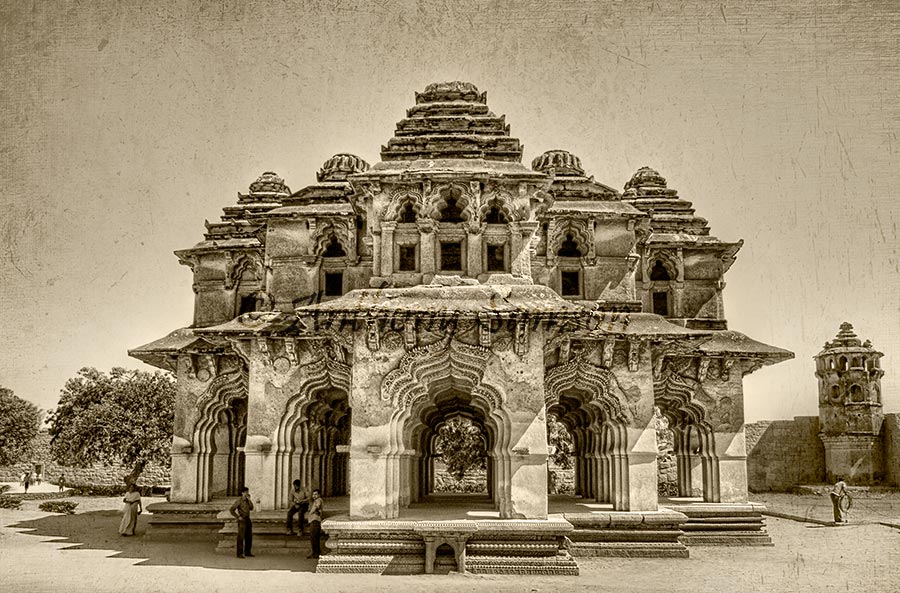
Lotus Mahal is an highlight in Zenana Enclosure and is one of the most photographed building in Hampi, it is symmetrically laid out, with equal projections on four sides.The archways and the balcony with the domed construction resemble a half opened lotus bud and thus gets its name Lotus Mahal.

Lotus Mahal, Hampi (HDR Image with texture)
HDR Image of Lotus Mahal, Hampi.
Lotus Mahal is made out of lime mortar and brick unlike any other structures in hampi, it stands near to the middle of a high walled compound in the northeast corner of the Royal Centre. Octagonal and square watchtowers are built into the compound walls. Its built in Indo-Islamic style and is a curious mix of Hindu temple like elements and Islamic sultanate elements.

HDR Image with sepia tone, I kinda like this one, Which one do you like
Lotus Mahal in Hampi.
The exact function of this is not surely known. some say this was a socializing area for the women folks in the royal family and some say it served as a meeting place of the emperor and his closest advisors. It is said that water used to be poured on the roof of the mahal, the pillars and the roof absorb this water and give a cooling effect, something like a AC Room.

To get regular updates, you can sign in as follower or subscribe to RSS or Email Feed
Skywatch / Foto Friday / Best Shot / Photostory / Scenic Sunday / My World / Shadow Shot / Blue Monday / Outdoor Wednesday / Creative Exchange 

December 7, 2010

Chandragiri Hill Temple


This huge, beautiful Jain temple is built on Chandragiri hill at Shravanabelagola and dates back to 3rd Century BC.  Chavundaraya basadi (red arrow), Chandragupta Basadi (square complex before the pillar), was built by Emperor Ashoka in the 3rd Century BC and is dedicated to Emperor Chandragupta Maurya.  The pillar is called Mahasthambha (great pillar).  Chandragiri also has memorials to numerous monks who have meditated here since the 5th century AD.

Did you notice group of people in the bottom right corner of the image, see how tiny they look, this should give you an idea of the scale of this temple.

September 11, 2010

Melkote Temple

HDR image of temple in melkote as seen from the pushkarni

Melkote is one of the sacred places in Karnataka. This place is also known as Thirunarayanapuram. It is built on rocky hills known as Yadavagiri or Yadugiri overlooking the Cauvery valley.  On top of the hill is an impressive Yoga Narasimha Swamy Temple which dates back to 12th Century.

May 23, 2010

Gumbaz, Srirangapatna

This Beautiful tomb was built by Tipu Sultan as a tribute to his illustrious father, Hyder Ali (1722-1784 A.D.), after his death. The Gumbaz is situated at the eastern extreme of Srirangapatna. It Enshrines the cenotaphs of Hyder Ali, his wife Fakr-Un-Nisa and Tipu Sultan, after his death in 1799 A.D. The structur is laid out amidst a garden, Typical of Islamic architecture.


April 12, 2010

Offering Prayer


A priest standing in front of colosul statue of Lord Gomateshwara (Bahubali) and offering prayer.  One has to climb few more steps after reach Odegal Basti (Triple Shrine Temple) on Vindyagiri Hill in Shravanabelagola.  More to come from this place....

April 5, 2010

Odegal Basati


HDR Image of Odegal Basti
Odegal Basti is located at Shravanabelagola and is datable to 14th Century A.D. Odegal Basti is so called because of the stone props against its basement (Odegal means broken stones). It is the only Trikutachala (triple-shrine) temple at Shravanabelagola. It is called the triple-shrine because of the three Sanctums present inside the temple.

March 8, 2010

Colonel Bailey's Dungeon

Named after Colonel Bailey who died here in 1782 A.D. This dungeon lies North of famous Ranganatha Swamy temple in Srirangapatna. The oblong bastion referred to as Sultan Bateri, conceals the vaulted dungeon measuring 30.5 mts x 12.2 mts. Dungeon is built in brick and mortar.

This dungeon was used to imprison Tipu's prisoners of war, Prisoners were chained to the stone slabs (can be seen in the picture below) fixed on the east, North and West walls. One of cannons rolled back and fell into the dungeon piercing the ceiling which can be seen even today.

March 6, 2010

Keshava Temple

A sculpture of Godess Lakshmi in her dancing form found on outer wall of Keshava Temple at Somnathpur which is belived to be built around 1268 A.D.

November 8, 2009

Masjid E-Ala

The Masjid-e-Ala or Jama Masjid in Srirangapatna is Major tourist attraction in the city and is at a walkable distance from the Srirangapatna bus stop. The mosque is located near the Bangalore Gate of the fort. Tippu Sultan built this masjid in 1784. 


The mosque has tall minarets which seems to touch the sky and the minarets stand on a high platform and has an open court in the front and a covered verandah. The minarets are double storied and octagonal in shape with pigeonholes surmounted by domes that adds to the grandeur of the entire structure. 

Masjid has a huge prayer hall and there are about 200 steps leading to the top of the minarets from where one can have a splendid view of the surrounding area.


Friends